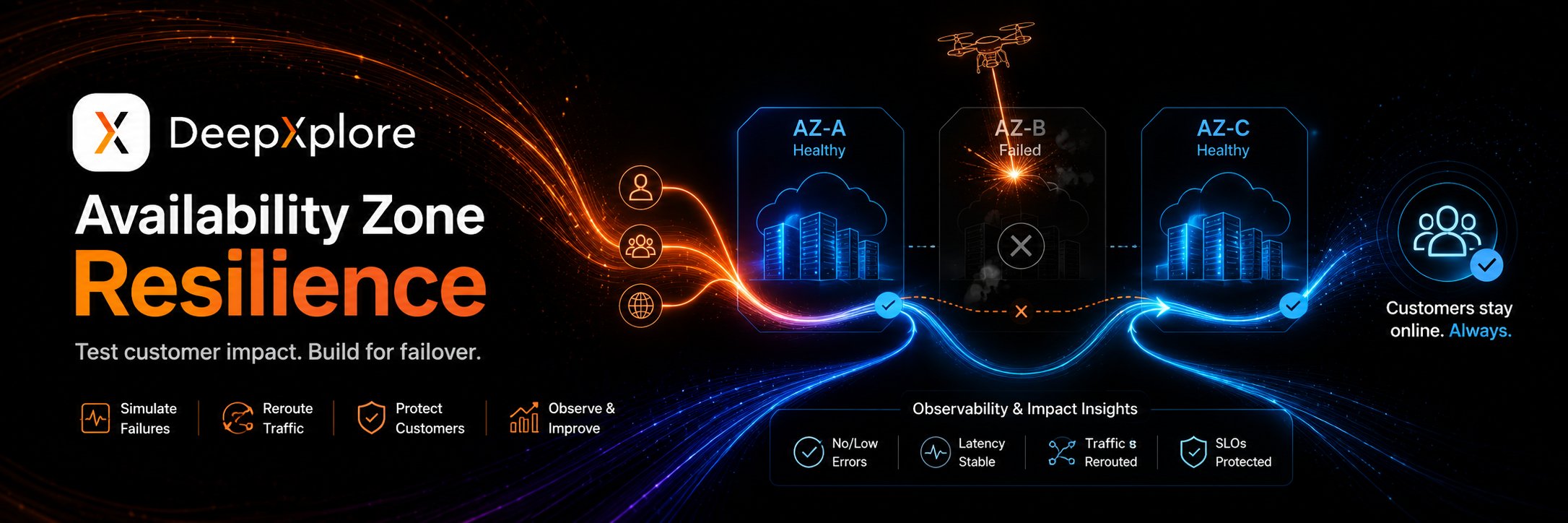
In March 2026, drone strikes damaged AWS data centers in the UAE and Bahrain, taking multiple availability zones offline for hours. The targeting did not stop there: Iran later claimed a cruise missile strike on Amazon data infrastructure in Bahrain, after additional reported drone attacks on the same region. Customers who assumed their workloads were redundant across zones discovered — in production, under fire — that they were not. Services went dark. SLAs were breached. Revenue was lost.
The question every infrastructure team should be asking is not if an availability zone will fail, but whether your customers will notice when it does.
The false comfort of multi-AZ deployments
Most teams believe they are AZ-resilient because their Terraform declares
availability_zones = ["a", "b", "c"]. But declaration is not validation. Common
failure modes hide in plain sight:
- Stateful services pinned to a single AZ — databases, caches, or message brokers that never actually failover under load.
- Uneven instance distribution — auto-scaling groups that concentrate capacity in one zone during scale-down events.
- Cross-AZ dependencies — a service in AZ-1 that calls a dependency hard-wired to AZ-2, creating a hidden single point of failure.
- DNS and load-balancer misconfigurations — health checks that do not remove a failed zone quickly enough, causing customer-visible errors during the failover window.
You cannot fix what you have not tested. And you cannot test AZ failure in production without risking the very outage you are trying to prevent.
How DeepXplore tests AZ resilience
DeepXplore performance tests simulate real user traffic against your infrastructure while you take availability zones out of the path. The platform measures whether latency, error rates, and throughput remain within your SLO boundaries when a zone disappears.
The diagram below shows the difference between an AZ-redundant architecture and a single-AZ architecture under the same failure condition:
On the left, traffic distributes across three zones. When AZ-2 goes down, AZ-1 and AZ-3 absorb the load and customers see no impact. On the right, all traffic flows through a single zone. When that zone fails, there is nowhere to reroute — customers experience an outage.
From detection to remediation with DeepXplore Code
Finding the problem is only half the battle. DeepXplore Code uses the organization knowledge graph to trace single-AZ dependencies back to the specific infrastructure-as-code that created them, then suggests targeted changes to introduce redundancy.
The knowledge graph connects your services, infrastructure code, and runtime topology. When DeepXplore identifies a single-AZ dependency during a performance test, Code agents trace it back to the Terraform module or Kubernetes manifest that created the constraint, then propose changes that introduce multi-AZ redundancy and improved failover.
What a resilience test looks like in practice
A typical AZ resilience test with DeepXplore follows three phases:
1. Baseline measurement
DeepXplore generates realistic user traffic against your production-like environment with all availability zones healthy. This establishes your baseline latency, throughput, and error rate under normal conditions.
2. Zone failure injection
You systematically take each availability zone out of the traffic path — one at a time — while DeepXplore maintains the same load profile. The platform measures whether your SLOs hold during the failover window and under sustained single-zone-down operation.
3. Gap analysis and remediation
If any metric breaches your SLO threshold during the test, DeepXplore flags the specific service and dependency path that caused the degradation. DeepXplore Code then proposes infrastructure changes to close the gap — whether that means adding a read replica in a second zone, adjusting auto-scaling policies, or fixing a hard-coded endpoint.
Why this matters now
The events of 2026 — from the March drone strikes through subsequent claimed missile attacks on cloud infrastructure — proved that availability zone failures are not just theoretical chaos engineering scenarios. They are real-world risks driven by geopolitics, natural disasters, power grid failures, and human error. The organizations that survived without customer impact were the ones who had already validated their multi-AZ architecture under realistic failure conditions.
DeepXplore makes that validation continuous, automated, and actionable. Instead of a once-a-year game day that tests one failure mode, you get ongoing assurance that every deployment maintains AZ resilience — and automated remediation when it does not.
Your infrastructure declares it is redundant. DeepXplore proves it.