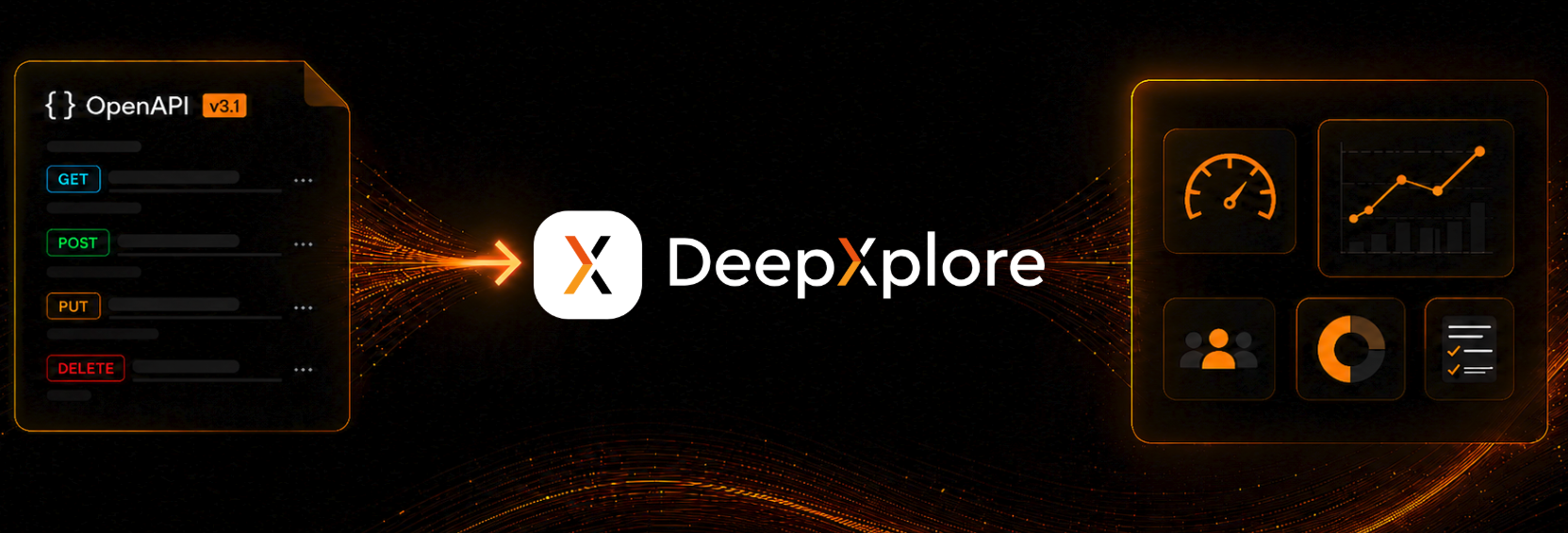
Creating performance tests yourself is a time-consuming endeavor. Someone has to read the API, invent the journeys customers actually take, wire data from one step into the next, invent realistic payloads, and tune the load profile. That work routinely takes days of specialist time — and by the time the suite is ready, the contract has already moved.
With OpenAPI generation, that same path is a matter of minutes: import the spec, review the candidate Heliosruns, and run them. The contract you already maintain becomes the test plan you never had time to write.
- OpenAPI spec sits unused
- Specialists hand-write scripts
- Sparse endpoint tests
- Coverage lags the release

- Import the OpenAPI spec
- Journeys generated in minutes
- Reviewed Heliosrun candidates
- Run against your Infrastructure
Days of manual authoring versus minutes from spec to a reviewed performance Test.
APIs ship weekly. Load tests do not.
The gap is not a missing tool — it is the cost of authorship. A specialist who understands both the product and the load-testing stack is expensive, scarce, and usually assigned to the last incident, not the next release.
What gets written in that crunch is usually the cheapest thing: isolated endpoint scripts. Hit GET /products ten thousand times. That is not how customers use the product, and it is not how revenue breaks. Checkout fails when a catalog identifier never makes it into the cart, or when a session expires between pay and confirm. Those defects live in the chain, not in a single URL.
OpenAPI generation compresses the authorship bottleneck. The spec already names the operations, the schemas, and the relationships. DeepXplore reads that contract and produces journey-level Heliosruns instead of a pile of disconnected calls.
What a DeepXplore Heliosrun is
A Heliosrun is an executable performance test in which virtual users walk real API journeys against a target environment. It is not a flood of identical GETs. It is browse, then cart, then checkout, then pay — each step carrying the identifiers the previous step returned, under the load profile you chose.
That is the difference between proving an endpoint is fast and proving the customer path still works when traffic rises. Isolated calls can all pass while the chain that generates revenue fails.
Why “Helios”? Named for the Greek sun god who crossed the sky each day and saw everything on earth — a witness to plots, secrets, and broken oaths. A Heliosrun is meant to see the same: how the system actually behaves under load, not how a single endpoint looks in isolation.
How generation works
You import an OpenAPI specification and set the basics: authentication, the load profile, and which modules to apply. DeepXplore then treats the spec as a map of how customers move through the API.
The work that used to take a specialist days — reading the contract, inventing flows, wiring correlation, filling payloads — happens in minutes. You still decide what to run. You do not spend a sprint writing it.
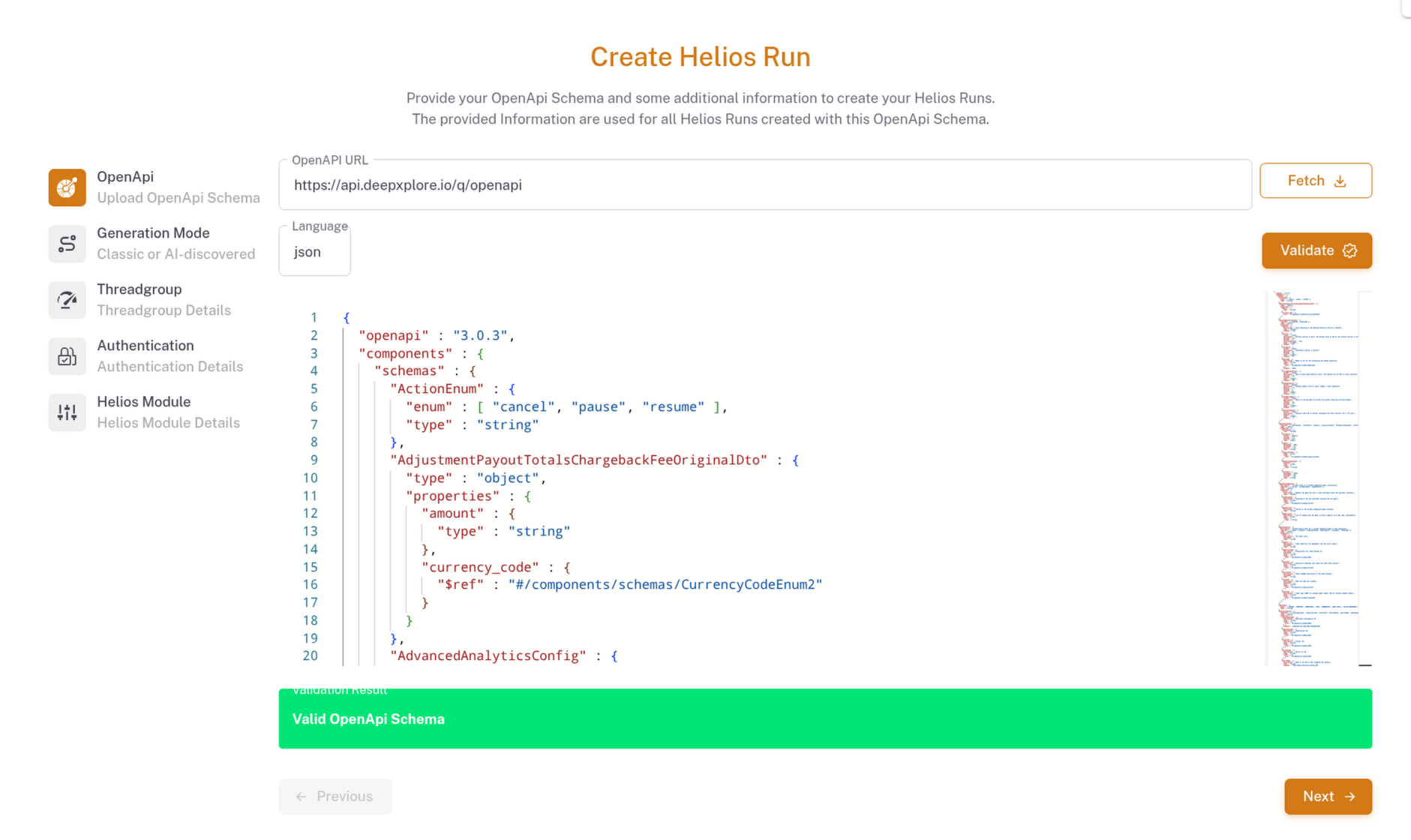
DeepXplore starts from your real contract, so journeys and parameters are generated with the correct shapes. Import the OpenAPI spec and let the platform validate it before anything is built. That keeps the rest of the pipeline grounded in the API you actually ship, not a hand-written guess.
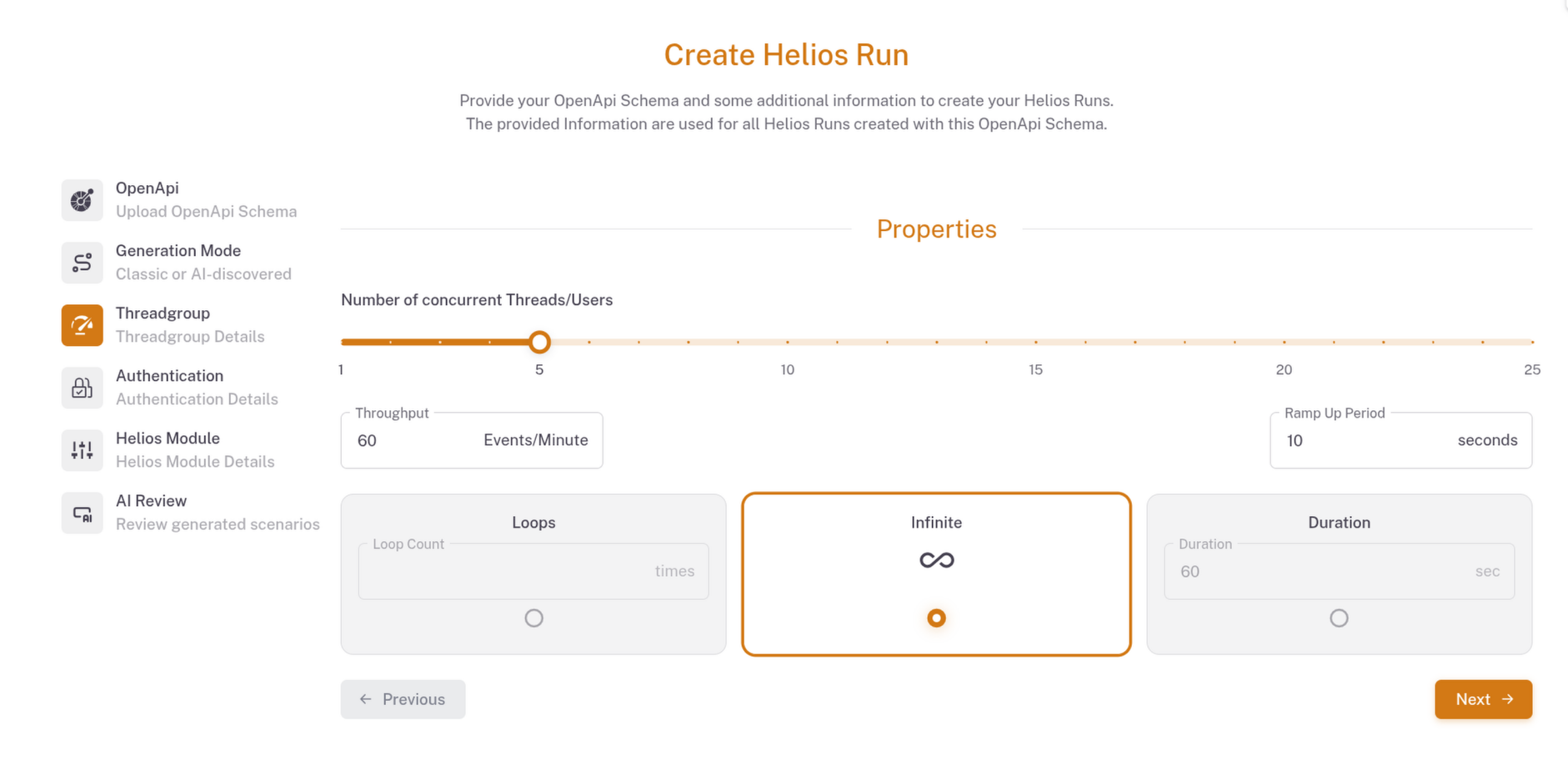
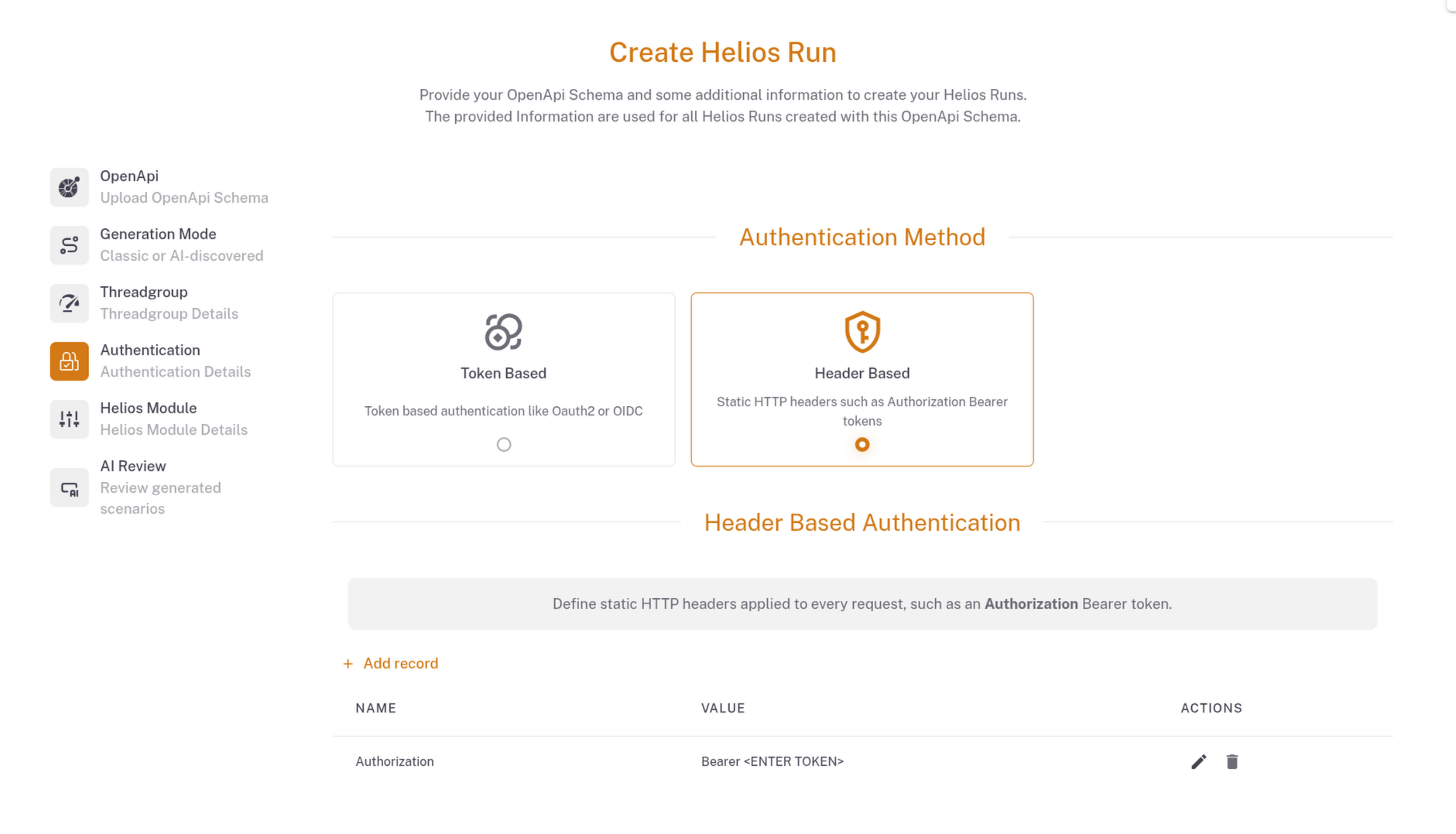
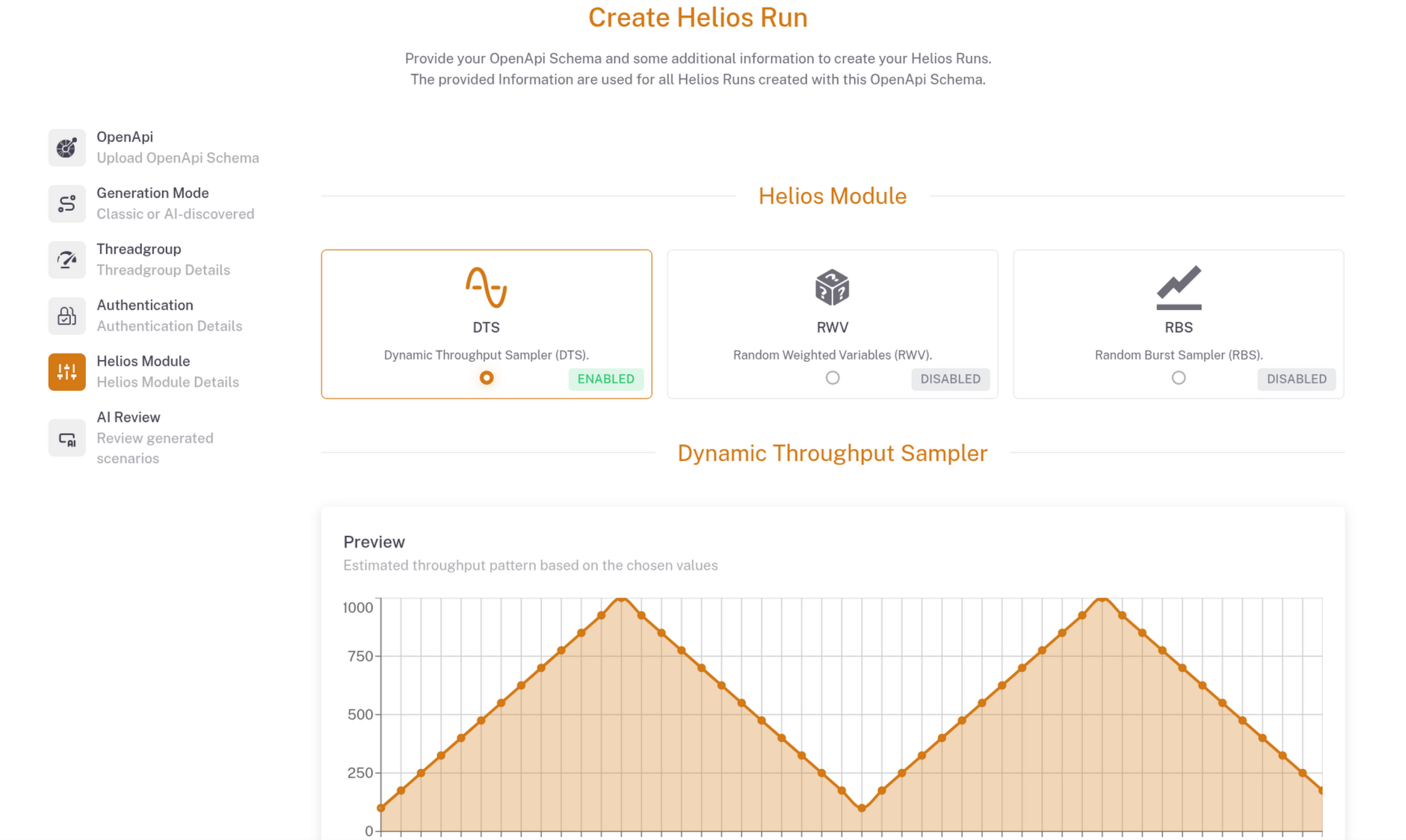
Choose your general test settings: thread properties, authentication, and the scenario scope to generate. These controls define how hard the run should push and how requests are authorized. Once they are set, generation can reuse them across every journey instead of asking specialists to wire them by hand.
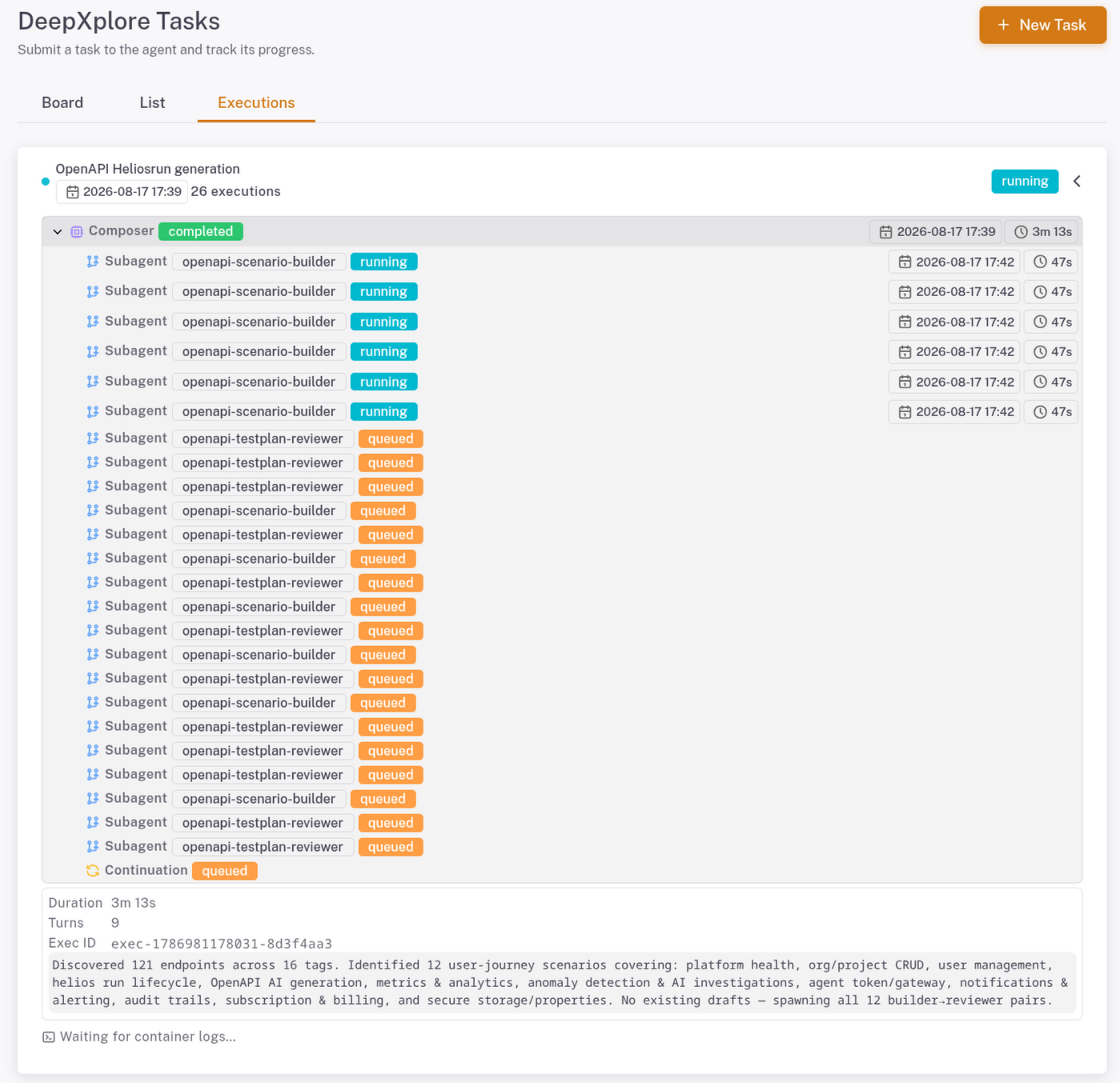
Automated user-journey detection by the composer, plus fan-out of builder/reviewer pairs to build the test. The composer reads the spec as a map of how customers move through the API: checkout-style chains, CRUD flows, and the endpoints that still matter on their own. Each journey then gets its own builder and reviewer, rather than being squeezed into a single hand-written script.
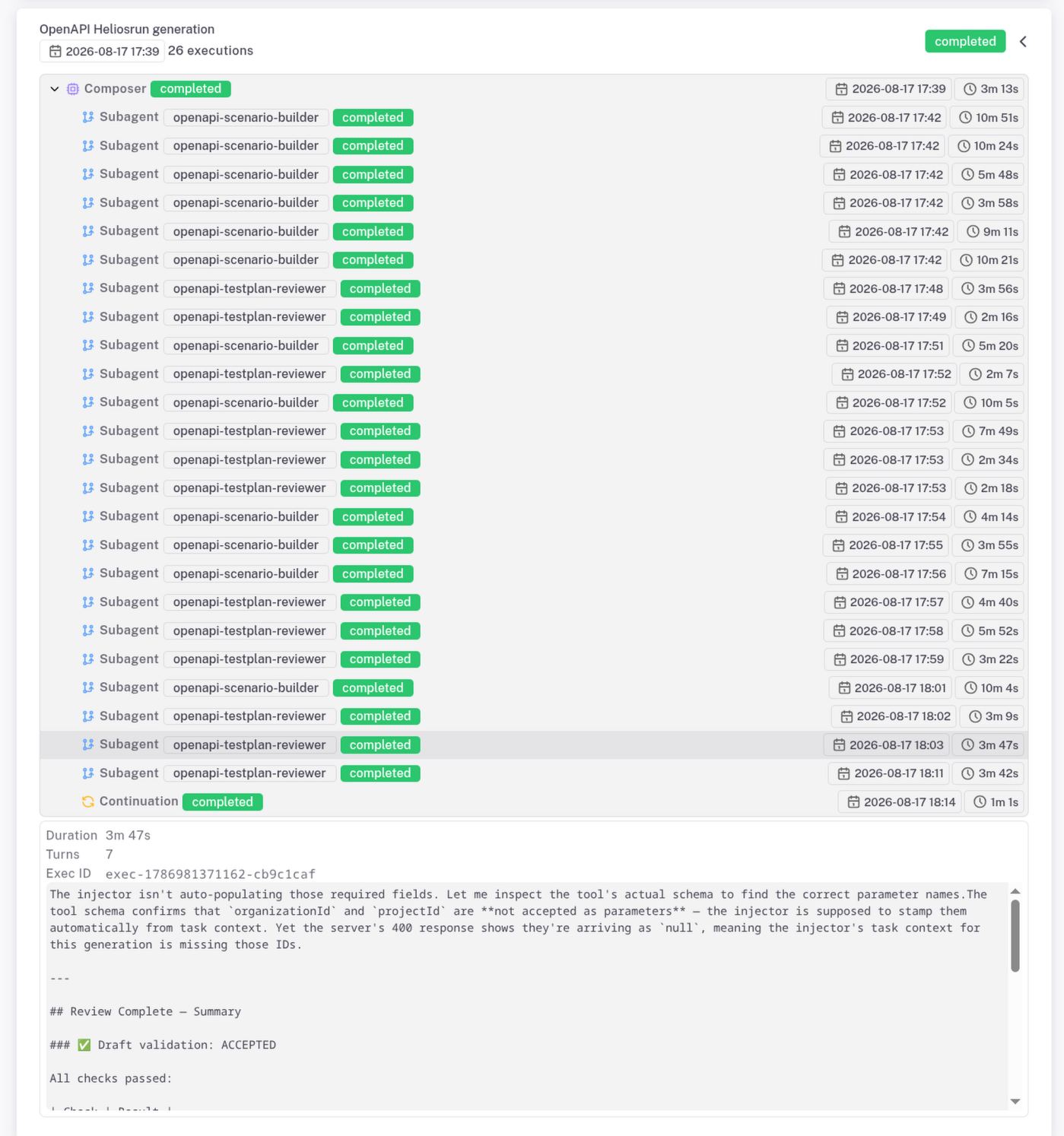
A builder draft gets produced from the contract, then a reviewer QA-pairs with it: the reviewer validates that the journey is coherent and ready to run. That second pass checks sequence, data flow between steps, and whether the plan is structurally valid. Only accepted journeys become candidates; rejected ones go back for rework instead of slipping into a run.
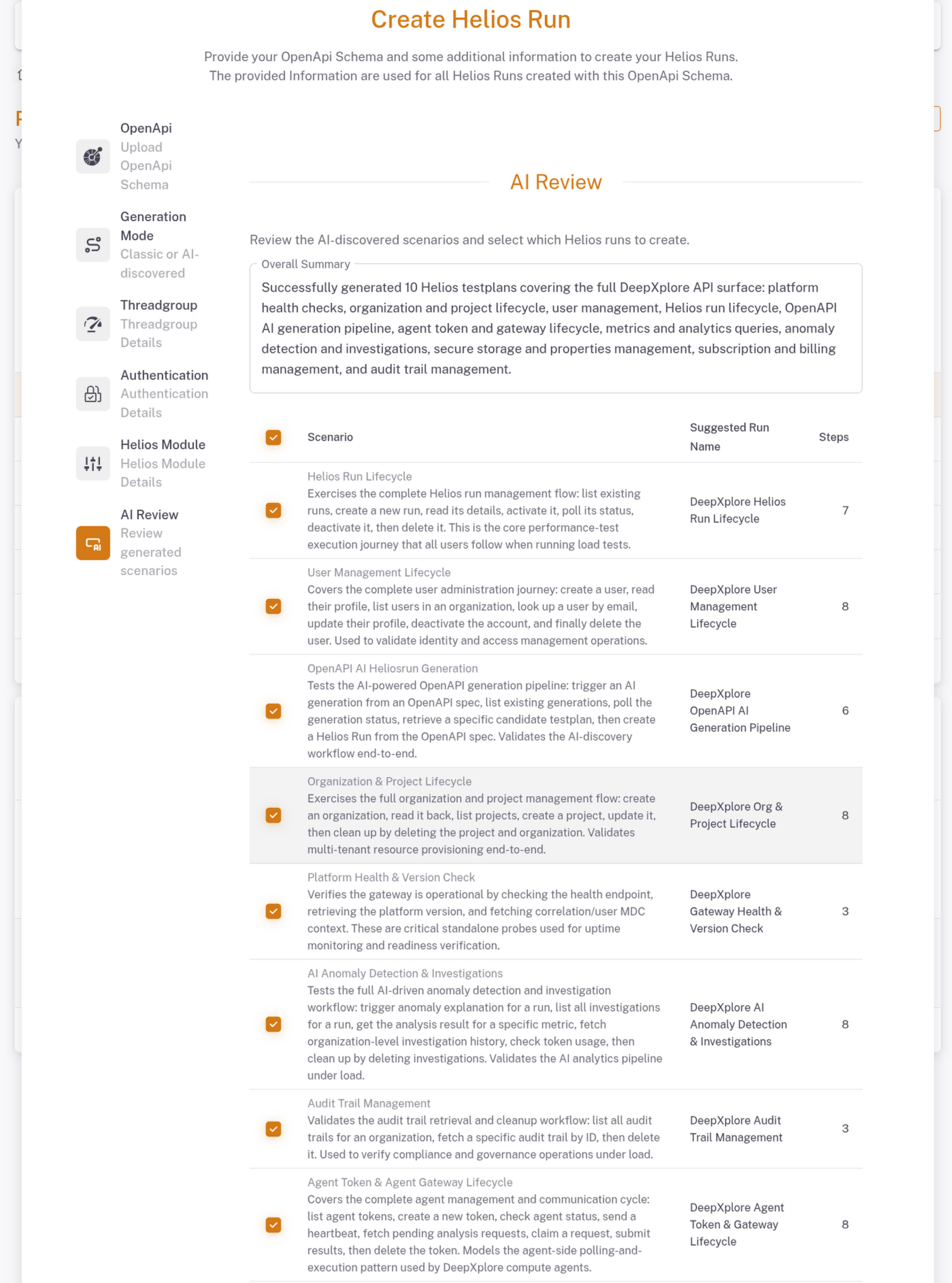
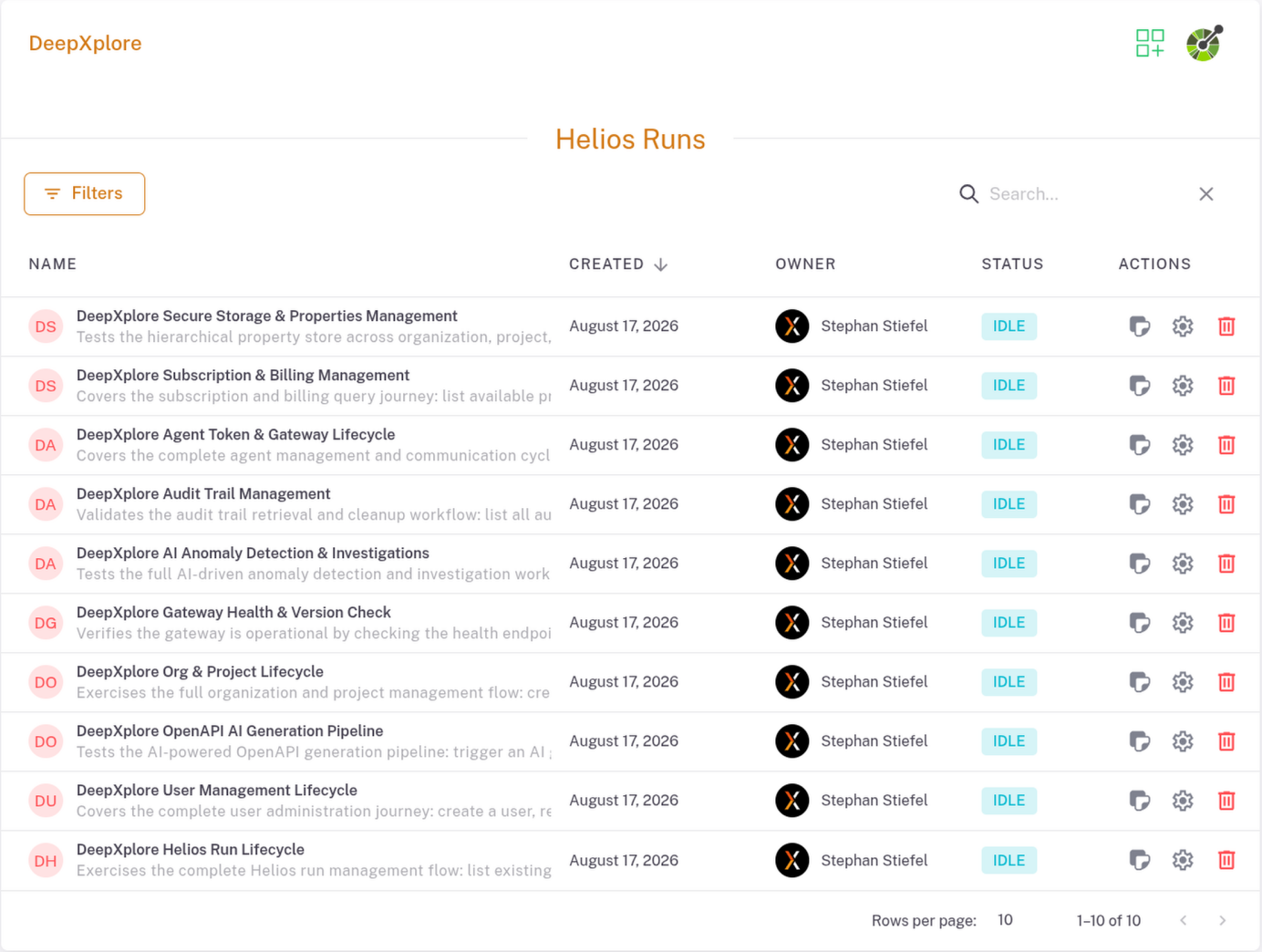
Select scenarios and create ready-to-run Heliosrun candidates you can execute. You still decide which journeys matter for the release: checkout, onboarding, or the critical standalone endpoints. DeepXplore turns the accepted plans into Heliosruns without another round of specialist scripting.
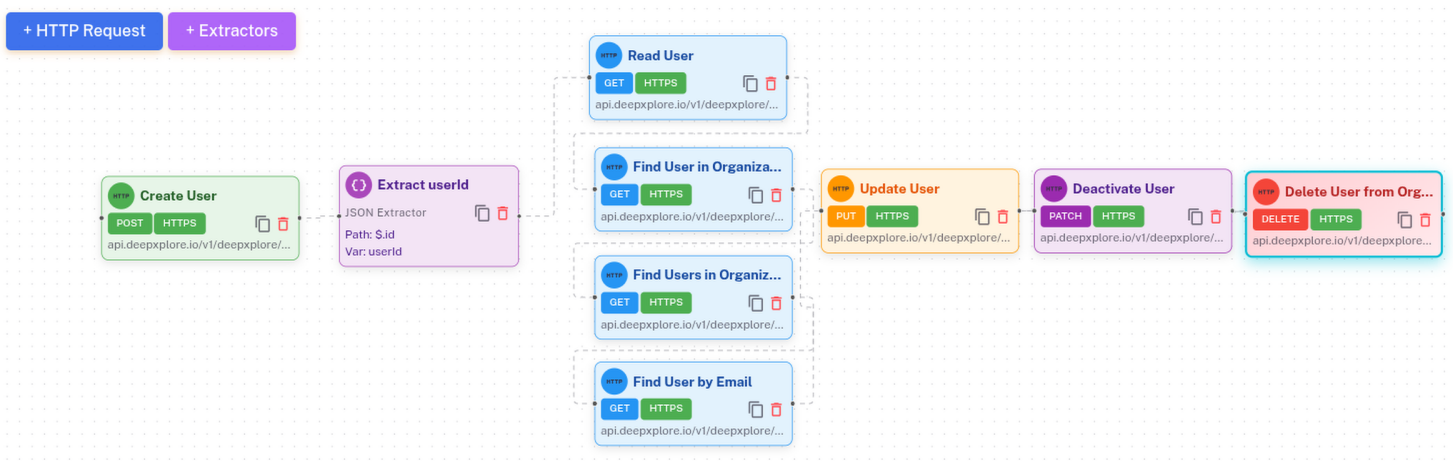
Virtual users execute the concatenated journey end-to-end against your infrastructure. Each step carries identifiers from the previous response, the same way a real customer session would. That is the difference between proving one endpoint is fast and proving the revenue path still works under load.
From contract to candidate to run: generation is the path, review is the gate.
Why the review gate matters
Generated tests are not dumped into your environment blindly. One agent builds a journey from the spec. A second agent reviews it: does the sequence make sense, do values flow between steps, is the plan structurally valid? Only accepted journeys become candidates.
That is the managerial point. Speed without a quality gate is just a faster way to run the wrong test. The review step exists so you get a usable Heliosrun quickly, without accepting a journey that would fail for the wrong reasons.
Why journeys beat single endpoints
Real users do not call a single API. They browse, add to cart, check out, and pay. DeepXplore chains those requests into stateful journeys and wires the data flow between them — the same model described in our user journey testing write-up.
When the catalog returns a product identifier, the next step uses it. When checkout returns an order identifier, payment consumes it. Each virtual user carries its own state, so ten thousand concurrent shoppers do not share one cart.
Isolated endpoint tests can all pass while this chain fails under load.
What you get back in minutes
The headline is time. Hand-authoring performance tests is a time-consuming endeavor. OpenAPI generation turns that into minutes: import, review, run. The rest of the value follows from that compression.
- Minutes, not weeks, to a meaningful first test. Coverage can keep up with the release cadence instead of trailing it by a sprint.
- Tests follow revenue paths. Journeys from the contract exercise the chains customers actually take, not the endpoints that were easiest to script.
- The spec stays the source of truth. When the API changes, you regenerate. Tests do not drift into a private folklore of scripts.
- Synthetic data, not production PII. Generated payloads use realistic, distribution-aware values so you are not copying live customer records into a load test. See Intelligent Test Generation for the product view.
- Specialists spend time on risk, not boilerplate. The scarce people on your team review candidates and interpret results instead of writing extractors and sample bodies.
What you do next
Import the OpenAPI spec. Review the candidate Heliosruns. Start the ones that cover the journeys you care about. From there you are on the rest of the DeepXplore path: live reporting, baseline comparison, and root cause analysis when a run breaks an SLA.
The contract is already in the repo. The tests do not have to wait weeks to join it.