AI coding assistants made individual output look great. More commits. More completed tickets. Dashboard green. But system-level delivery — lead time, MTTR, deployment frequency — often stayed flat or got worse. That gap is the AI productivity paradox.
The constraint did not disappear. It moved. When models draft code without runtime context, review and verification absorb the load. Teams merge more PRs that take longer to review and break production more often. Lines of AI-generated code become a vanity metric.
The heavy toll of context blindness
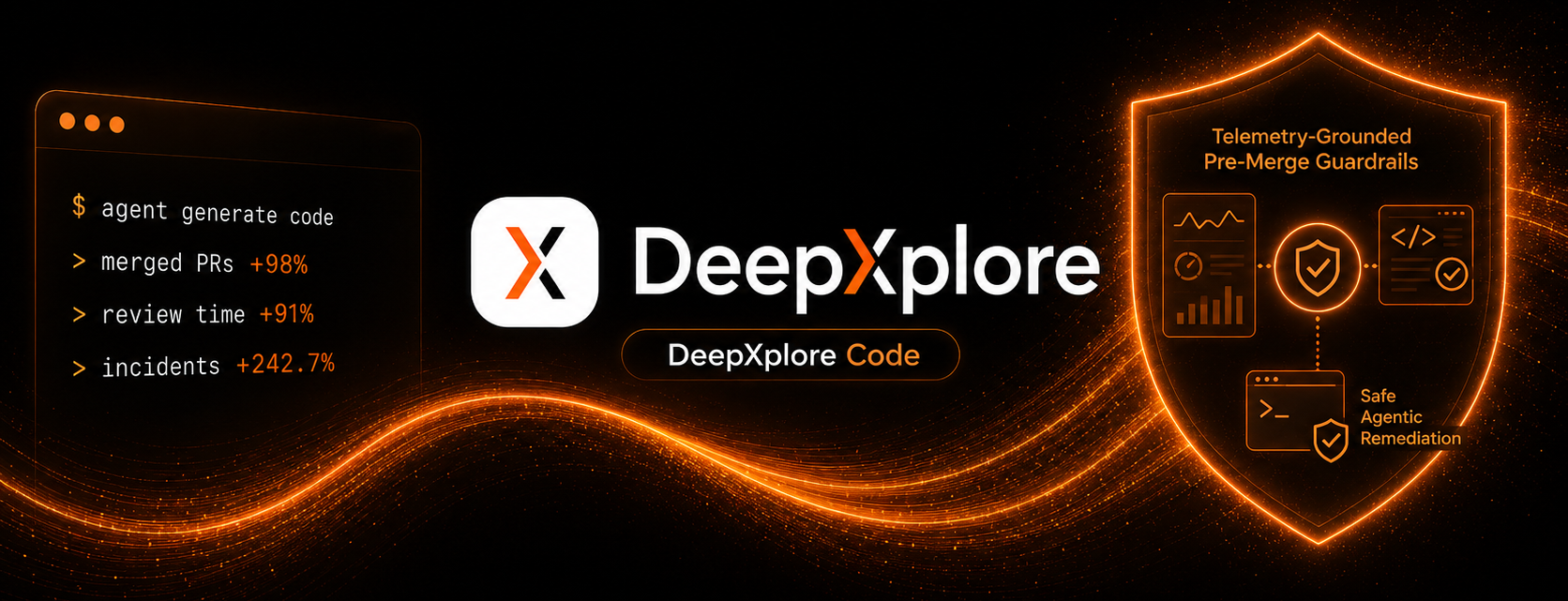
Faros AI’s 2026 telemetry report tracked ~22,000 developers across 4,000+ teams. High AI adoption looked like a win upstream: merged PRs up 98%, completed tasks up 21%. Downstream, the bill came due.
Upstream gains
Downstream cost
Figure: Under high AI adoption, Faros AI’s 2026 data shows more merged PRs and completed tasks — alongside much longer reviews, larger diffs, higher churn, and a sharp rise in incidents per PR.
First-generation assistants write in an operational vacuum. No live latency signals, no cross-service map, no history of what already failed in production. Humans then carry the full validation cost — and production feels the misses.
When verification cannot keep up
Amplify generation without scaling review and the queue explodes. Research on large PR corpora shows AI output can roughly double per-reviewer load. Reviewers spend more time hunting subtle regressions in larger diffs.
Under that pressure, shortcuts appear. Faros data showed a 31.3% rise in PRs merged with no human or agentic review, and an 11.7% drop in weekly deployment frequency. More drafts, fewer safe ships. Spend per merged change often climbs once you count rework and incident response.
Ground the agent in operational reality
The fix is not to abandon agents. It is to stop launching them into your codebase with no durable memory of how the system actually works.
We wrote about that failure mode in Nine Seconds From Staging to Gone: most coding agents start at zero. Every run, you pour skills, rules, and repo context back into the prompt. That burns context window, drifts under compaction, and is failure-prone when the only fence is text the model may forget. Soft guardrails do not hold when the agent can reach live systems.
DeepXplore avoids that half of the productivity paradox with isolated agent runners that already have access to your organization knowledge graph — services, repos, dependencies, and topology — instead of re-teaching the model from a blank session. Execution stays in a managed environment you grant permissions to; the graph supplies durable context the prompt does not have to carry alone.
That foundation still needs an outer verification loop. DeepXplore sits on your existing observability stack so detection and diagnosis catch what generation still misses:
- Performance Tests catch latency and reliability risk before release.
- Root Cause Analysis correlates metrics, logs, and traces in seconds.
- DeepXplore Code investigates with that context, maps cross-service impact, and opens a targeted PR.
- Performance Tests run again so the fix is proven before merge.
Figure: closed loop — isolated runners plus knowledge graph write the change; perf tests and RCA catch regressions faster when something still slips.
Reviewers still approve the change. They approve smaller, context-backed diffs instead of thrashing through oversized, blind drafts.
Measure fixes, not drafts
AI should cut toil, not relocate it into review queues and war rooms. Track lead time, change failure rate, and ticket-to-fix cycle time — not raw AI line counts.
Grounded agents turn unverified drafts into mergeable PRs. Teams using DeepXplore Code shrink ticket-to-fix cycle time by about 5× without replacing the tools they already run. Stop paying for context blindness. Ship changes your infrastructure already understands.
Dig into the product loop on DeepXplore Code or the architecture write-up Agentic Engineering Beyond the Repo.
Sources
- The AI Productivity Paradox: Why AI Adoption Hasn’t Made Engineering Faster — Augment Code (includes Faros AI 2026 telemetry figures cited above)